
 admin
Air suspension replaces conventional steel coil or leaf springs with heavy-duty reinforced rubber air bellows on one or both axles. Its primary advantage is adaptability: the system actively adjusts to changing vehicle loads and, depending on the model, alters ride height on command. While this creates a noticeably smoother ride and keeps a fully loaded chassis level, it also introduces mechanical and pneumatic components that require targeted troubleshooting when problems arise.
Understanding what each component does simplifies ownership and prevents costly, speculative parts replacement.
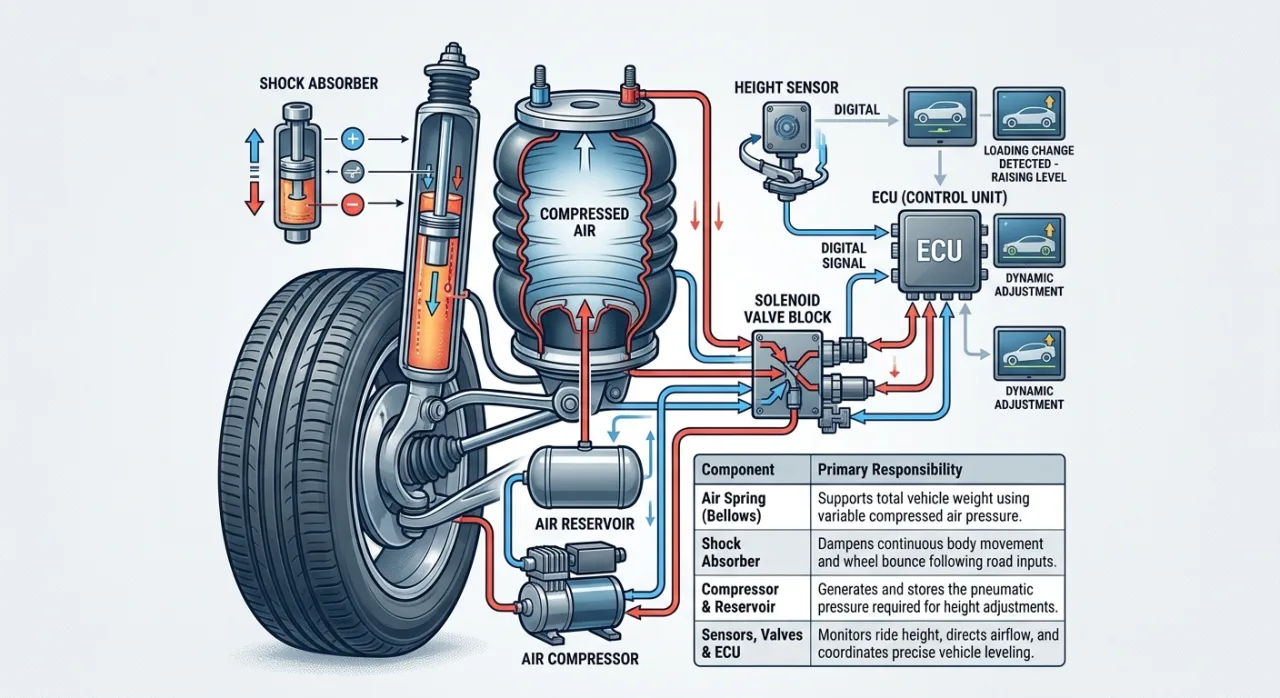
Core Mechanics: How Air Suspension Works
Inside an air spring, compressed air provides the primary cushioning effect. When a wheel hits a bump, the air spring compresses and expands. A dedicated shock absorber controls this movement to prevent the vehicle body from bouncing continuously afterward. Depending on your vehicle’s layout, these components sit separately or combine into an integrated strut assembly.
A high-pressure compressor supplies the necessary air volume, while solenoid valves route it through the network. Height sensors continuously report the body’s position relative to the suspension. The Electronic Control Unit (ECU) processes this data to raise or lower specific corners instantly as passenger weight or luggage changes.
Key Air Suspension Components
| Component | Primary Responsibility |
| Air Spring (Bellows) | Supports total vehicle weight using variable compressed air pressure. |
| Shock Absorber | Dampens continuous body movement and wheel bounce following road inputs. |
| Compressor & Reservoir | Generates and stores the pneumatic pressure required for height adjustments. |
| Sensors, Valves & ECU | Monitors ride height, directs airflow, and coordinates precise vehicle leveling. |
Air Suspension vs. Adaptive Damping
Drivers often confuse air springs with adaptive damping, but they perform distinct roles:
-
Air Suspension: Replaces physical steel springs with compressed air to manage load capacity, ride height, and overall spring rate.
-
Adaptive Damping: Adjusts the firmness of the shock absorbers electronically, regardless of whether the springs are steel or pneumatic.
A car can feature electronically controlled dampers while riding on traditional steel springs. Consequently, selecting a “Sport” or “Comfort” drive mode on your dashboard does not automatically indicate that your vehicle has air springs fitted.
Hardware configurations also vary significantly within the same vehicle lineup. For example, the 2013 BMW X5 offered an optional Comfort Adaptive Suspension package that combined rear air suspension with electronically controlled dampers. That specific setup applies to vehicles equipped with that option not every X5 on the road.
When sourcing replacement air suspension components, rely on the exact vehicle generation, axle position, factory suspension code, and original part reference number rather than the brand badge alone. A replacement part that appears identical on the outside may belong to a completely different drivetrain layout or damping configuration.
Common Faults and Diagnostic Clues
Adding pneumatic and electronic controls creates specific failure points over time. Rubber bellows gradually degrade, fitting seals dry out, and electrical faults can interrupt level signals.
Important Diagnostic Note: If your vehicle sags at one corner overnight, do not immediately assume the air spring itself is broken. A leaking valve block, a split airline, or a faulty check valve can produce identical symptoms.
[ Air Leak in System ] ──> [ Constant Pressure Loss ] ──> [ Compressor Overworks ] ──> [ Burned-Out Compressor ]
The air compressor frequently falls victim to external air leaks. When air escapes from a loose connector or damaged bellows, the compressor runs continuously to maintain system pressure. Replacing a burnt-out compressor without repairing the underlying air leak will cause the new unit to fail prematurely.
Details to Provide Your Mechanic
To ensure accurate diagnostic work, provide your repair shop with clear context:
-
Timing: Did the vehicle drop suddenly while driving, or slowly sink overnight?
-
Stance: Which specific corner or axle sags on level ground?
-
Dashboard Warnings: What exact error messages appear, and under what driving conditions?
-
Audible Clues: Has the compressor tone changed, or is it running significantly longer than usual?
Installation Guidelines & Maintenance Best Practices
Always inspect air suspension components alongside tires, steering joints, and brake systems. Have your mechanic assess both the pneumatic circuit and the mechanical suspension links a worn ball joint or damaged tire will not be fixed by installing a new air spring.
Proper installation procedure is vital. Compressed air connections and residual pressure valves require careful handling during replacement:
-
Follow Exact Torque Specs: There is no universal torque value for pneumatic fittings. Overtightening will ruin brass threads and rubber seals, while undertightening causes slow leaks.
-
Model-Specific Protocols: Air suspension systems require precise depressurization, chassis support, and controlled refilling procedures using dedicated scan tools. Improvised roadside repairs often destroy new air bellows instantly.
-
Safety First: If your vehicle sits abnormally low, a tire rubs against the fender liner, or a critical chassis warning light illuminates, pull over safely immediately. Never drive a vehicle sitting on its bump stops.